A Brief History of Western

 Monasticism


Written by Robert Jones

robertcjones@mindspring.com

Click here to see other courses that I've written

Click here to go to the Christian History & Theology home page


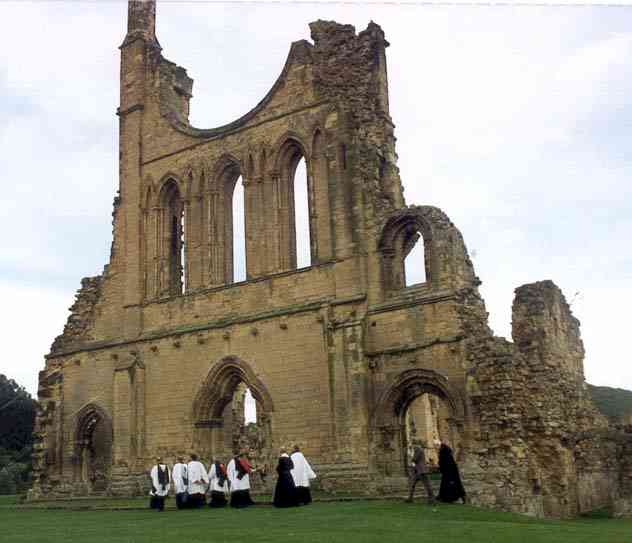
An Anglican Church Service begins in the ruins of the Abbey Church at Byland Abbey, a former Cistercian monastery in North Yorkshire, England (founded 1134; dissolved Nov. 1538)
Photo by Robert Jones

This material may be reprinted free of charge for use by non-profit church groups, as long as the author and copyright information is retained. 


Would you like to teach this course? 

$20.00 - You can purchase a Teacher's Pack, containing:


Click here to order via post

OR

(Note: Clicking on the "PayPal Buy Now" button allows you to order via MasterCard or Visa. You do not have to have a PayPal account.)


Copyright 2000 by Robert C. Jones

I'd love to hear about anyone that uses this material in their Sunday School classes!

robertcjones@mindspring.com

"Scripture taken from the HOLY BIBLE, NEW
INTERNATIONAL VERSION.  Copyright
Ó 1973,
1978, 1984 by International Bible Society.  Used by
permission of Zondervan Publishing House."


Table of Contents

Table of Contents

Introduction

Glossary

Timeline

Predecessors and antecedents

Nazirites

“Sons of Zadok” and the Essenes

The Early Christians

The desert monks

The first Western monastic movements

Joseph of Arimathea

St. Benedict – The Rule of Benedict

Celtic Monasticism

The great medieval Orders

Benedictines

The Cluniacs

Carthusians

Bernard of Clairvaux & the Cistercians

The Canons

The military orders - Knights Templar, Knights Hospitalers

The rise of Friars – Dominicans & Franciscans

The Medieval monastery

Monastic buildings

The decline of monasticism

The Black Death

Laxness in the monastery

The Reformation

The French Revolution

Western Monasticism today

Conclusion

Sources

Other Christian History & Theology courses

Introduction

For 700 years, medieval monasteries in Europe were the spiritual, agricultural, educational, legal, and administrative centers of the areas in which they were located.  Following a daily routine of prayer, solitude, and physical labor, the monasteries provided a refuge from the cruel world that was Medieval Europe.  In addition, it was the monks (and nuns) of these monasteries who kept alive the spark of knowledge in the West through their patient preservation and hand copying of ancient texts (both Christian and Classical).

I’ve long had an interest in Western monasticism.  From the period from 1985-1992, I was able to visit over 40 medieval monasteries in England and Wales, adding to my interest in the topic.  I am pleased to contribute this booklet to the knowledge of the subject.

This booklet will discuss the antecedents of the Western monastic movement (both Jewish and Christian), examine its founders and greatest influences (St. Antony, St. Benedict, St. Bernard of Clairvaux), and finally, discuss the downfall of the monastic movement. 

Glossary

·        Abbey – religious community presided over by an abbot or an abbess

·        Abbess – head of a nunnery (or, occasionally, head of a double monastery – St. Hilda of Whitby)

·        Abbot – head of an abbey. “In the monastery, he is considered to represent the person of Christ.” (Rule of Benedict Chapter II)

·        Cenobites – monks that live in a monastic community, typically under an abbot

·        Dissolution of the Monasteries – the disbanding of the monasteries in England by King Henry VIII (1536/40)

·        Hermits (or anchorites) – ascetic solitaries, typically not part of a defined monastic order

·        Lay brother (especially Cistercian) – member of monastery not required to observe the complete holy office.  Often involved in manual labor.

·        Monk – from Gr. monos, man by himself; member of a monastic religious order,  Bound to vows of poverty, chastity and obedience.  A.K.A. “a religious”.

·        Prior – second in command to an abbot, or head of a priory

·        Priory – smaller monastic house than an abbey.  Often a daughter house of an abbey (all Cluniac houses were priories, except for the one at Cluny).  Headed by a prior.

Timeline

Date

Event

1st century

First virgins consecrated to Christ – daughters of Deacon Philip in Acts 21:9

251 A.D.

Early Christian hermit St. Antony is born

3rd century

Clement of Alexandria, Origen, Tertullian, and Cyprian all praise asceticism

320

Pachomius (293-346) founds monastery at Tabennisi in Egypt; later founds nearby nunnery with over 400 nuns

c. 330

St. Amoun and St. Macarius create monasteries in the Egyptian desert

c. 341

Synod at Gangra expresses disapproval of monks that entirely give up church attendance

c. 356

St. Basil (330-379) joins a monastery in Asia Minor; begins work on his Rules for monastic living.

386 A.D.

St. Jerome founds monasteries in Bethlehem

4th century

Monasteries begin to appear in the West – St. Ambrose at Milan, St. Hilary at Poitiers, etc.

401

St. Augustine of Hippo writes On the Works of Monks to encourage monks to do manual labor and to earn their own “keep”

c. 480

Birth of St. Benedict

5th century

·         Laura organizations appear in Judean desert; several generally solitary monks gathered around one leader – common prayers and meals (similar to later Carthusians)

·         Symeon the Stylite (c. 390 – 459) lives on top of a column (monastery of Telanissos in Syria)

·         St. Patrick brings Christianity to Ireland

c. 526

Rule of Benedict written

c. 550

Death of St. Benedict

c. 563

St. Columba founds a monastery at Iona, for the purpose of converting Scotland to Christianity

597

St. Augustine, prior of St. Andrew’s monastery in Rome, is sent to England as a missionary by Pope Gregory I

c. 663

Synod of Whitby (hosted by St. Hilda) resolves differences between Celtic and Roman Christianity

731

Bede completes History of the English Church and People

late 8th-century

Abbeys of northern and eastern England destroyed by Viking raiders (Lindisfarne sacked in 793)

909

Berno founds the monastic house of Cluny.

936

Abbot Laffredus of Farfa in Lazio is poisoned by two of his monks, for trying to enforce the Benedictine rule

c. 943

St. Dunstan begins monastic reform movement in England

c. 970

English bishops and abbots/abbesses meet with King Edgar to create the Regularis Concordia, a constitution for English monasticism.  Some practices were peculiar to English monasticism – lay people attending Sunday Mass at the monastic church, for example

1084

St. Bruno founds the Carthusians

1098

Cistercian order founded in Citeaux by Robert Molêsme

1099

First Crusade captures Jerusalem

1115

St. Bernard founds new Cistercian abbey at Clairvaux

1118

Hugh de Payens and eight companions form the Knights Templar in Jerusalem

1127

St. Bernard writes Apologia – an indictment of the Cluniacs

1128

Knights Templar adopt Cistercian rule

1170

Birth of St. Dominic in Castile, Spain

1181

Birth of St. Francis of Assisi

1210

Franciscan Order recognized by Pope Innocent III

1217

Pope Honorius III licenses the creation of the “Order of Preachers”, later known as the Dominicans

1221

Death of St. Dominic, founder of the Dominican Order

1228

Francis of Assisi canonized

1233

The Dominicans are given the task of running the courts of the Inquisition

1291

Last Christian stronghold in the Holy Lands falls (Acre)

1323

Pope John XXII supports the idea that Christ and the Apostles did not practice absolute poverty – a blow to the stricter Franciscans of the day

1328

Franciscan Spiritual William of Ockham (Ockham’s Razor) excommunicated for insisting on strict poverty for monks

1347/51

Bubonic and Pneumonic Plague sweeps through Europe and England; many monasteries devastated

1517

Martin Luther tacks 95 Theses to the door of Wittenburg Castle, launching the Protestant Reformation

1534

Society of Jesus (Jesuits) formed by Saint Ignatius of Loyola

1536/40

800 religious communities in England and Wales are dissolved by Henry VIII and his secretary Thomas Cromwell

1662

Armand Jean Le Bouthillier de Rancé, abbot of the Cistercian abbey Notre Dame de la Trappe, France, forms the Trappists (Cistercians of the Strict Observance)

1732

Protestant Seventh Day Baptists found mixed-gender monastery in Ephrata, Pennsylvania

1790

Cistercian and Cluniac orders suppressed in France by the French Revolution

1798

Knights of Malta (former Knights Hospitalers) defeated by Napolean I

1830

St. Bernard is declared a doctor of the Church by Pope Pius VIII

1944

The Trappist Monastery of the Holy Spirit in Conyers, Georgia is founded

Predecessors and antecedents

The monastic movement which swelled in the West in the 6th and 7th centuries had both Christian and Jewish predecessors. 

Nazirites

The Jewish Nazirites, who are mentioned as early as the Pentateuch in the Old Testament, were not a monastic order per se, but made it possible for those that wanted to make a “special vow, a vow of separation to the LORD”.  The Christian monks later echoed these ideas of separation from the normal, and of making a vow to God (Medieval monks vowed poverty, chastity and obedience).  The Book of Numbers lists some of the requirements for becoming a Nazirite:

“2“Speak to the Israelites and say to them: ‘If a man or woman wants to make a special vow, a vow of separation to the LORD as a Nazirite, 3he must abstain from wine and other fermented drink…5“During the entire period of his vow of separation no razor may be used on his head. He must be holy until the period of his separation to the LORD is over; he must let the hair of his head grow long. 6Throughout the period of his separation to the LORD he must not go near a dead body. …8Throughout the period of his separation he is consecrated to the LORD.”  (Numbers 6, NIV)

 There appeared to have been two types of Nazirites.  The first type (probably a minority) were dedicated at birth:

·        Samson (Judges 13:7)

·        Samuel (1 Sam 1:11)

·        John the Baptist (Luke 1:15)

 (The Benedictines would later accept children to be entered into the order for life.)

 The second type (probably the most numerous) made their vow for a specified period of time.  The most famous is Paul of Tarsus (Acts 18:18).

“Sons of Zadok” and the Essenes

Manual of Discipline:  “And this is the order for the men of the community who have offered themselves to turn from all evil and to lay hold of all that he commanded according to his will, to be separated from the congregation of the men of error, to become a community in law and in wealth, answering when asked by the sons of Zadok, the priests who keep the covenant...” (The Dead Sea Scrolls, Millar Burrows, p. 376)

Among the 800 scrolls found in caves above the Dead Sea settlement of Qumran were 10+ copies of each of two documents that appear to be the rules or “constitution” of a Second Temple Jewish “monastic” order.  The documents in question are The Manual of Discipline (or the Rule of the Community), and the Damascus Document (fragments of which were also found in Cairo in 1897).  Neither document reveals the name of the community that wrote them, other than the nomenclature "Sons of Zadok".

While one must be careful to not assign attributes of Medieval Christian monasticism to a Jewish religious sect  that existed before Christ, there are some remarkable similarities between the rules outlined in the two documents, and the later Christian monastic rules, such as the 6th century Rule of Benedict.  Some of the rules and attributes of the “Sons of Zadok” which seem to closely parallel the later Christian monastic rules include:

·        They were headed by a “superintendent” or “examiner”, who seemed to be both teacher and Chief Financial Officer

·        Judicial decisions were made by the assembled members of the group

·        Apparently there was community ownership of property

·        There appears to have been a required two-stage (one year each) probation period for entry into the sect

·        At some point they appear to have separated themselves from the rest of Judaism, and settle in a remote area (“When these things come to pass for the community in Israel, by these regulations they shall be separated from the midst of the session of the men of error to go to the wilderness to prepare there the way of the LORD...”  (from the Manual of Discipline, Burrows, 382)

·        Prayer was an important element of their daily worship

·        Those that violated Mosaic law and the community rule willfully were excommunicated

·        They scrupulously obeyed the Sabbath

So, who were the “Sons of Zadok”?  The most common explanation by modern day scholars is that they were Essenes, the mysterious religious group named by 1st century historians Josephus and Pliny the Elder:

“On the west side of the Dead Sea, but out of range of the exhalations of the coast, is the solitary tribe of the Essenes, which is remarkable beyond all other tribes in the whole world, as it has no women and has renounced all sexual desire, has no money, and has only palm trees for company…”  (Pliny the Elder, Natural History; translation from The People of the Dead Sea Scrolls: Essenes or Sadducees?, James C. Vanderkam, Bible Review, April 1991)

Whether or not the community of the Manual of Discipline and the Damascus Document were Essenes or not, they do appear to have been a 1st or 2nd-century B.C. Jewish monastic group, whose rules were either later emulated or paralleled by St. Benedict, St. Augustine, and others.

The Early Christians

An obvious “early Christian” role-model for later monastic ascetics is to be found in the person of John the Baptist, who preached in the Judean desert, and wore clothes of “camel’s hair”:

“1In those days John the Baptist came, preaching in the Desert of Judea…4John’s clothes were made of camel’s hair, and he had a leather belt around his waist. His food was locusts and wild honey. 5People went out to him from Jerusalem and all Judea and the whole region of the Jordan. 6Confessing their sins, they were baptized by him in the Jordan River.”  (Matthew 3, NIV)

John the Baptist is also one of the several Nazirites mentioned in the Bible that were dedicated at birth to the discipline:

“He is never to take wine or other fermented drink, and he will be filled with the Holy Spirit even from birth.” (Luke 1:15, NIV)

Elements that would later be echoed in Western monasticism can also be found in the “primitive” early church as described in Acts.  Attributes such as sharing possessions, continual fellowship, teaching and learning, and communal meals were all part of very early Christian practice, as these passages from Acts discuss (see also Acts 4:32-37):

“42They continually devoted themselves to the teaching of the apostles, to fellowship, to the breaking of bread, and to prayer. 43A sense of awe came over everyone, and many wonders and signs were being done by the apostles. 44All the believers were together, and they shared everything with one another. 45They made it their practice to sell their possessions and goods and to distribute the proceeds to anyone who was in need. 46They had a single purpose and went to the Temple every day. They ate at each other’s homes and shared their food with glad and humble hearts. 47They kept praising God and enjoying the good will of all the people. And every day the Lord was adding to them people who were being saved.” (Acts 2:42-47, NIV)

There also seems to be some admiration of celibacy and/or singleness in the early church, as these passages from Acts, 1 Corinthians, and 4th-century Bishop Eusebius indicate:

“7On finishing the voyage from Tyre, we arrived at Ptolemais, greeted the brothers, and stayed with them for one day. 8The next day we left and came to Caesarea. We went to the home of Philip the evangelist, one of the seven, and stayed with him. 9He had four unmarried daughters who could prophesy.”  (Acts 21:7-9, NIV)

“8Now to the unmarried and the widows I say: It is good for them to stay unmarried, as I am.” (1 Cor 7:8)

“For in Asia also great lights have fallen asleep, which shall rise again on the last day, at the coming of the Lord, when he shall come with glory from heaven and shall seek out all the saints. Among these are Philip, one of the twelve apostles, who sleeps in Hierapolis, and his two aged virgin daughters, and another daughter who lived in the Holy Spirit and now rests at Ephesus...” (Eusebius, quoting Polycrates, Ecclesiastical History, Book 3, Chapter 31)

The desert monks

“...he [St. Antony] persuaded many to embrace the solitary life. And thus it happened in the end that cells arose even in the mountains, and the desert was colonized by monks, who came forth from their own people, and enrolled themselves for the citizenship in the heavens.” (Life of St. Antony, by Bishop Athanasius, Chapter 14)

As early as second century, there were small groups of Christians that renounced marriage and possessions, and lived in remote places.  However, Christian monasticism as we know it today probably started in the deserts of Egypt in the late-3rd and 4th centuries.  These early monks in Egypt are known as the “desert monks”, or “the ascetics”. 

Some scholars believe that the growth of the desert ascetic movement was in response to the growing cosmopolitan nature of the Church – in c. 312 A.D., the Emperor Constantine converted to Christianity, and eventually made Christianity the official religion of the combined (east and west) Roman empire.  Could the Church remain pure while exercising great political and economic power and control? 

Some of the desert monks sought to emulate the lives of the Christian martyrs.  Others believed that the path to salvation was through constant prayer and supplication to God.  This raised a disturbing question that would be raised time and time again throughout the history of monasticism – is a monastic life “dedicated to God” “better” than the lives of normal church-going folks?  Better than the non-monastic priests, bishops, and other clerics?   And if so, does this mean that there are two “gradients” of Christians?  Is one more “saved” than the other?  Does “subduing natural urges” (one of the goals of the ascetics) attain greater favor in heaven?

One of the earliest of the desert monks is St. Antony (251-356).  He is also one of the most famous, by virtue of the Life of Antony, written by Bishop Athanasius of Alexandria around the time of Antony’s death.  (Athansius was famous for his anti-Arian writings, as well as his Paschal letter 39, which is the oldest extant listing of the books of the New Testament as we know them today).  We will examine St. Antony in some detail, as an example of the desert monk movement.

St. Antony was Egyptian by birth, born into a wealthy family.  Upon the death of his parents, Antony renounced his wealth, put a young sister into a convent to be raised, and retired to tombs located outside of his village.  Later, he moved into an abandoned fort in a remote mountain area, and resided there for 20 years.  Finally, he moved to another area with a spring at the foot of a mountain, where he lived out the rest of his 105 years.

According to the Life of Antony, Antony lived a very severe and ascetic life:

“… he was ever fasting, and he had a garment of hair on the inside, while the outside was skin, which he kept until his end. And he neither bathed his body with water to free himself from filth, nor did he ever wash his feet nor even endure so much as to put them into water, unless compelled by necessity. Nor did any one even see him unclothed, nor his body naked at all, except after his death, when he was buried.” (Life of Antony, Chapter 48)

One of the reasons for the severe life led by Antony was his constant battles with the devil – a recurrent theme throughout his biography:

“But Antony having learned from the Scriptures that the devices of the devil are many, zealously continued the discipline, reckoning that though the devil had not been able to deceive his heart by bodily pleasure, he would endeavor to ensnare him by other means. For the demon loves sin. Wherefore more and more he repressed the body and kept it in subjection, lest haply having conquered on one side, he should be dragged down on the other. He therefore planned to accustom himself to a severer mode of life.” (Life of Antony, Chapter 7)

In time, as the fame of Antony spread, cells of monks grew up around Antony’s cell, and looked to him for leadership (according to Athanasius, Constantine himself once wrote to St. Antony asking for advice!):

“So their cells were in the mountains, like filled with holy bands of men who sang psalms, loved reading, fasted, prayed, rejoiced in the hope of things to come, labored in alms-giving, and preserved love and harmony one with another…For then there was neither the evil-doer, nor the injured, nor the reproaches of the tax-gatherer: but instead a multitude of ascetics; and the one purpose of them all was to aim at virtue.” (Life of Antony, Chapter 44)

Athanasius (who may have had his own agenda) records that Antony was anti-Arian (as was Athanasius), and always bowed down to local ecclesiastical rule (something which not all monks would do in the future – Cluniacs, Knights Templar, etc.)  Antony also “worked, however with his hands, having heard, ‘he who is idle let him not eat,’ and part he spent on bread and part he gave to the needy.” (Life of Antony, Chapter 3)

During his long life (105 years), Antony is credited with performing many miracles (including bringing water out of dry land), as well as having the power to heal.  This desert monk (with some help from Bishop Athanasius) would have a lasting influence on Christian monasticism.  (“For not from writings, nor from worldly wisdom, nor through any art, was Antony renowned, but solely from his piety towards God.” (Life of Antony, Chapter 93)

Antony was not alone in his desert monk-ship.  Other monks contemporary with Antony founded monasteries or nunneries in the desert, including St. Pachomius, who in 320 founded a monastery at Tabennisi in Egypt, and Sts. Amoun and Macarius in c. 330.

In c. 356, St. Basil (330-379) joined a monastery in Asia Minor, and began work on one of the first “rules” for monastic living (which Benedict credits in his famous rule as one of his inspirations).

 Several of the post-Nicene Church Fathers either started monasteries, or were monks themselves, including St. Athanasius, St. Augustine of Hippo (North Africa), and St. Jerome (Bethlehem).

The first Western monastic movements

Joseph of Arimathea

Medieval legend, at least, records that the first monastic settlement in the West was by Joseph of Arimathea in England at Glastonbury, in the first century (37 A.D. or 63 A.D., depending on the source).  The basic tenants of this legend (relating to the monastic establisment) go something like this:

·        In the year 63 A.D. (or, possibly, earlier) Joseph is sent by the Apostle Philip from Gaul to England, with 11 (or 12, in some accounts) disciples, one of whom is his son Josephes

·        Joseph lands in the British west country (Somerset), and is granted some land on the Island of Yniswitrin ("Isle of Glass") by a local King, Arviragus

·        Joseph and his followers create an ascetic community

·        At the bidding of the archangel Gabriel, they build a church of daub and wattle in honor of the Blessed Mary.

·        After the death of Joseph and his followers, the site is abandoned. Later, the great Benedictine monastery of Glastonbury is built on the site.

The legend is remembered today because it also records that Joseph brought with him (variously) two cruets "filled with blood and sweat of the prophet Jesus", collected when Joseph took Jesus down from the cross, or the Cup from the Last Supper (a.k.a. the Holy Grail, or the Sangreal).

Is there any chance that the legends are true?  Tertullian as early as the third century reported that “the haunts of the Britons” were “subjected to Christ”. Gildas the Wise (500? - 572? A.D.) reported that the British Isles received the “holy precepts of Christ” in the “latter part of the reign of Tiberius Caesar” (who died in 37 A.D.)

Whether true or no, the monastic settlement ascribed to Joseph of Arimathea didn’t last.  But other early Western monastic settlements would.

 St. Benedict – The Rule of Benedict

“The reason we have written this rule is that, by observing it in monasteries, we can show that we have some degree of virtue and the beginnings of monastic life.”  (The Rule of St. Benedict in English, 1981, The Order of St. Benedict).

Much of Western monasticism as we know it today can fairly be traced to a 6th-century Italian monk named St. Benedict of Nursia (c. 480-550). The little that we know about Benedict comes from St. Gregory the Great’s Life of St. Benedict written around 593/94.  According to Gregory, Benedict started his monastic career by living in solitude in a cave at Subiaco, Italy, 30 miles east of Rome, to escape the paganism he saw in Rome.  In time, other monks asked him to be their leader, and he eventually started 12 monasteries of 12 monks each in the Subiaco area.

Around 529, Benedict founded the monastery of Monte Cassino, Italy (80 miles S. of Rome).  Also around this time, Benedict wrote his famous Rule for monastic life.  The Rule would be the basis for most Western monasticism for the next 1000 years, and is still an influence today.

The Rule of Benedict

Many of the precepts of Western monasticism were established in the Rule of Benedict.  Some of these are included below:


Precept

From the Rule

(All quotes from The Rule of Saint Benedict in English, The Liturgical Press, 1982)

“Therefore we intend to establish a school for the Lord’s service.  In drawing up its regulations, we hope to set down nothing harsh, nothing burdensome.” (Prologue)

12-month novitiate

“If after due reflection he promises to observe everything and to obey every command given him, let him be received into the community.” (Chapter 58)

Abolition of private property


“Above all, this evil practice must be uprooted and removed from the monastery.  We mean that without an order from the abbot, no one may presume to give, receive or retain anything as his own, nothing at all – not a book, writing tablets or stylus – in short, not a single item...” (Chapter 33) see also Acts 4:32

Communal meetings of the abbot and the monks (later to be known as Chapter House)

“As often as anything important is to be done in the monastery, the abbot shall call the whole community together and himself explain what the business is; and after hearing the advice of the brothers, let him ponder it and follow what he judges the wiser course.” (Chapter 3)

Communal sleeping arrangements (dormitory style)

“The monks are to sleep in separate beds...If possible, all are to sleep in one place...A lamp must be kept burning in the room until morning.” (Chapter 22)

Division of the day into seven offices

Lauds, Prime, Terce, Sext, Nones, Vespers, Compline – “Seven times a day I praise you for your righteous laws.” (Psalms 119:164, NIV)

Excommunication in degrees


Rebuking in front of the community, exclusion from table and oratory, shunning, “strokes of the rod”, banishment from the community

Humility

Benedict quotes from Luke “Whoever exalts himself shall be humbled, and whoever humbles himself shall be exalted.” (Chapter 7)

Importance of manual labor

“Idleness is the enemy of the soul.  Therefore, the brothers should have specified periods for manual labor as well as for prayerful reading.” (Chapter 48)

Obedience

“They no longer live by their own judgement, giving in to their whims and appetites; rather, they walk according to another’s decisions and directions, choosing to live in monasteries and to have an abbot over them.” (Chapter 5)

Reading accompanying meals

Church Fathers, Lives of the Saints, Bible

Rule by an abbott

“He is believed to hold the place of Christ in the monastery, since he is addressed by a title of Christ.” (Chapter 2)

Self-control


“We must then be on guard against any base desire, because death is stationed near the gateway of pleasure.” (Chapter 7)

Silence enforced except at prescribed times (Chapter); Laughter, gossip forbidden

“Monks should diligently cultivate silence at all times…” (Chapter 42)

Some positions within the community are defined in addition to the abbot

Cellarer – “...someone who is wise, mature in conduct, temparate, not an excessive eater, not proud, excitable, offensive, dilatory or wasteful...” (Chapter 31)

Prior - “The prior for his part is to carry out respectfully what his abbot assigns to him, and do nothing contrary to the abbot’s wishes or arrangements.”

Porter - “At the door of the monastery, place a sensible old man who knows how to take a message and deliver a reply, and whose age keeps him from roaming about.  This porter will need a room near the entrance so that visitors will always find him there to answer them.” (Chapter 66)


Celtic Monasticism

While “Roman” monasticism was thriving by the 6th century in places like Italy, France, and North Africa, an equally vibrant form of monasticism came out of Western Britain and Ireland – Celtic monasticism.  Celtic monasticism was more ascetic and disciplined than Roman monasticism, and tended to have less emphasis on the monastic community (monks often lived in individual cells).

Celtic monasticism was also avidly evangelistic, sending out missionaries to Scotland, Northumbria, and parts of Europe.  One of the most famous missionary journeys was that of St. Columba (c. 521-597), who established a monastery on the island of Iona, for the purpose of converting the Picts (Scotland).  St. Columban (c. 543 – 615) led a missionary journey to Europe, and founded monasteries in France and Italy (!)  Another famous missionary was Aidan, who founded a monastery at Lindisfarne in Northumbria, for the purpose of converting Northern England.

Celtic monasticism was also known for it’s emphasis on learning, and on preserving the great works of the past.  The most famous book of Celtic monasticism is the intricately illuminated Book of Kells, a copy of the Gospels dating to the 8th or 9th century.

Celtic monasticism didn’t follow the Benedictine Rule, nor did they view themselves as beholden to Rome.  Over time, they developed several practices that were different enough from Roman monasticism to attract the attention of Rome.  These differences included maintaining a different calendar than Rome (celebrating Easter on a different day), and wearing a different tonsure (shaving of all of the top of the head).

In 663, a great Synod was held at Whitby, under the patronage of Hilda of Whitby (614-680).  The Synod of Whitby (King Oswy making the final decision) decided against Celtic calendar and tonsure, ensuring that Celtic monasticism in the future would have a more Roman flavor.  Hilda in of her self is an interesting figure – she not only founded Whitby Abbey, but 5 future bishops trained in her “double monastery” (male and female) community.

Celtic monasticism might have become the predominant form of monasticism in Britain, had not Pope Gregory sent St. Augustine in 597 A.D. to bring Britain into the Roman fold.  Augustine founded several monasteries, and served as the first Archbishop of Canterbury.


Remains of 11th century Benedictine Monastery Whitby Abbey.  In 663, Whitby was the site of the Synod of Whitby, which decided in favor of Roman, rather than Celtic, monasticism.

The great medieval Orders

The zenith of Western monasticism was from the period starting with St. Benedict in the 6th century, lasting until about the 13th century.  But even during that period of ascendancy, Western monasticism still faced varying cycles of decline and reform.  As a matter of fact, as we discuss some of the major medieval orders in this next section, many of them were created to combat perceived laxity on the part of their antecedents.

The medieval monastic orders were also interesting studies in economics.  It seems that putting a bunch of zealous men that work for free in a rigidly controlled and disciplined environment can lead to great profits for the controlling authority – the monastery or the Order. A good example is the Cistercians, who became the leading wool merchants of their day, or the almost unimaginably wealthy Knights Templar.  In both cases, the profligate wealth eventually led to their downfall.

 Benedictines

The first and most influential of the great Medieval orders were the Benedictines, sometimes called the “Black Monks”, after the color of their robes.  This is the monastic order which grew out of the Rule of Benedict in the 6th century.  Many of the great monasteries of the Middle Ages were Benedictine, such as Glastonbury, Canterbury, and Whitby.  (Photo at right: Stained glass at Canterbury Cathedral, a former Benedictine monastery)

Their influence can not be underestimated.  Fifty Popes (including Pope Gregory the Great, father of Gregorian Chant) have come from the Benedictine order.  According to Microsoft Encarta Encyclopedia 99:

 “As early as 1354 the order had provided 24 popes, 200 cardinals, 7000 archbishops, 15,000 bishops, 1560 canonized saints, and 5000 holy persons worthy of canonization, a number since increased to 40,000…” ("Benedictines," Microsoft® Encarta® Encyclopedia 99. © 1993-1998 Microsoft Corporation)

During the Middle Ages, the abbot of a powerful Benedictine monastery often served as the local landlord, judge, and – in England –Parliamentarian.  The abbot, of course, also presided over his monks with almost total authority. 

Over